BBC #14: 2/4/14

Tommy Luginbill and Solair Systems, http://solairsystems.com/

Solair

Tommy Luginbill kicked off the Baltimore Business Club in 2014 by leading a discussion on his experiences starting a solar installation company, Solair Systems, but also dove into some broader topics that included his decision to attend business school at the University of MD.

Tommy had the distinct pleasure of attending the University of Delaware and graduating in 2009 with a degree in finance.  Rather than head into the corporate world, Tommy was drawn into Maryland’s emerging solar industry and helped start Solair Systems following graduation.  At Solair, they faced “normal” start-up pains in the beginning.  What does a Solair Customer look like?  Where and how do you find your first customers?  How do you reach those customers and why are you more attractive than an alternative?

Like many businesses, the the phones didn’t begin ringing off the hook the day they opened for business and launched a website.  He recalled facing moments of doubt that first year, working out of a (cold) garage and wondering if everything was really going to work.  But they were able to overcome these obstacles and found some of their most effective actions were utilizing their previous networks and really hustling to develop new ones.  Tommy emphasized this point throughout the discussion.  Get out there and meet people.  They may turn into your customers.  They may introduce you to customers.  Either way, without a corporate marketing budget, this is how small businesses can turn the corner and attract new business.

As the business started to grow, they were taking on both residential and commercial clients.  In the solar sector, although the skill set to handle these different types of installations is similar,  the customers do have different needs.  Over time, they found a niche in the mid-size commercial market, and began to cater more toward these clients.  The point Tommy made here was that although a wide variety of people may be able to use your products and services, it can sometimes be more beneficial NOT to cast a wide net and take on any and all new business.   Sometimes you can provide more value and create a more sustainable business if you target a specific market segment that compliments your capabilities.  It is similar to the old adage that 20% of your customers drives 80% of your business.  If you focus on that 20% and target similar customers, it can lead to a healthier business, even if it may cause you to lose out on some short term revenue.

In the middle of this proactive change toward targeting specific clients, they faced another situation that other businesses may face.  Solair was approached by another start-up in the energy efficiency sector to help build and launch their product.  The model was attractive, and many of Solair’s solar skill sets and networks transferred nicely over to this new opportunity.  And so they began paying less attention to their business’s bread and butter and more toward their new product offering in energy efficiency.

They dove into this new model under the handshake of equity.  The new product was unique and Solair felt like they could really build the business up using their solar skill sets, which they did.  However, as they put more and more time into this new venture, their solar business suffered, which was okay at first.  But about a year into this new venture, where they “assumed” equity as opposed to cash for their sales services, they eventually got whittled out.  Their equity agreements were not nearly as strong as once thought, and the thought of even attempting this kind of coup after building up an entire company’s customer base seemed unfathomable, but did occur.  And so Tommy’s big lesson from this experience was this: TAKE THE CASH.  When diving into something new and exciting, but where somebody else has their finger on the button, take the cash.  I’ve had a similar experience myself, and although it may not be advisable in every single situation, it certainly helps to be skeptical and fight through the initial excitement of something new.

Fortunately, they were able to overcome this adversity and refresh their solar business after putting it on the side for the better part of a year and have a much stronger focus on what they are really good at.  Additionally, the lack of knowledge that lead to their unforeseen obstacles drove Tommy to enroll at Maryland’s business school.  Although it is a brutal all day Saturday schedule, the education combined with the real world task of running the business is arming Solair with new vigor and a more complete skill set which should set them up nicely for years to come.

Overall, Tommy provided and a well rounded discussion on a variety of topics that served as a great start for the BBC in 2014.


BBC #13: 9/10/13

Wyatt Mackie on His Experiences with Wiley Gunters,  http://wileygunters.com/

wileygunters

For our main presentation, Wyatt Mackie discussed his experiences as a bartender/GM at the old Sly Fox Pub, his eventual buyout to full ownership and transition to Wiley Gunters.  Like most of our presentations, we held more of an open discussion with questions & answers throughout.  Wyatt also allowed us to host the meeting on the second floor of Wiley’s, which certainly added to the conversation.

Wyatt began working in the bar/restaurant business as a bartender while in school at Virginia Tech.  After graduation, he began working at Sly Fox Pub (old Wiley’s) on Fort Avenue in Baltimore as a bartender and became the General Manager relatively quickly.  The owners of Sly Fox owned other establishments in the Annapolis area and dedicated more of their time South and Baltimore.  This gave Wyatt a little more autonomy and responsibility than other GM’s might have in a similarly sized bar.  While GM at Sly Fox, the bar was doing okay (or slightly worse than okay) financially and the Fox brothers worked out a deal with Wyatt to trade part of his salary for equity, partly to help with cash flow.  This helped keep the bar open, and eventually led Wyatt to the opportunity to buyout the Fox brothers.

That opportunity came about three years ago when the brothers offered Wyatt the opportunity to buy them out and become the sole owner.  The negotiation process took about a year to complete, but Wyatt was able to combine his vested equity and take out a small business loan to cover the rest of the purchase price from the Fox’s in what both parties felt was a fair deal for Sly Fox.

The buyout was contingent on a few things, including a name change away from Sly Fox, for obvious reasons.  The deal closed around the summer of 2011 and the Fox’s did allow for a 1 year transition period to change the name, which would be accompanied by other renovations.  They allowed the one year transition because of football season around the corner, which is one of the more lucrative times for the bar, and it would have hurt the business to begin renovations during the season.

Once football season did end though, Wyatt began the name change and embarked on major renovations in February 2012.  This included fully renovating the downstairs and upstairs of the bar.  Rather than hiring a contractor to complete the work, Wyatt saved himself tens of thousands of dollars by doing the renovations himself and with the help of friends.  With two floors, he worked on them one at a time.  The full changes took about 8 months to complete, but he was able to keep the bar open throughout the process, keeping cash flow coming in while saving a ton of money in the process.  We’ve talked before about the importance of bootstrapping a business in the early stages and this was a great example and success story illustrating the importance of stretching financial resources as far as they can go.

Before Wyatt took over, the bar’s financial performance wasn’t awful, but it certainly had “room for improvement.”  Originally, Wyatt thought he could increase the customer base and make the bar more profitable with a goal of paying off his business loan in 5 years.  Thanks in part to bootstrapping his renovations and increasing the bar’s revenue, he is on track to pay it off in two.  This is a lesson we can all apply in life and other business ventures.  Sometimes it might make sense to keep on an original payback schedule, but if you can grow the business without reinvesting all the profits into growth while still growing, you can put yourself in a stronger financial position and give yourself more options in the future by paying off debt quicker.

One of those options for Wyatt is the possibility to purchase the building.  With a 5 year loan schedule, this was always possible, but was also a long term endeavor.  With the bar’s performance and financial discipline, this goal now moves from a long term objective to one with much closer and realistic prospects.

Throughout the discussion, we also addressed many of the questions we usually touch on when a live business is the topic including some of the lessons learned, biggest challenges faced, social media’s impact, the utilization of things like Groupon, and future plans.

Overall, the discussion offered excellent insight into a business we have yet to discuss at the BBC and we are all looking forward to see Wiley’s continue to grow and develop into one of the Fed Hill/Locust Point’s premier bar/restaurants.


Mike Kirby and Elon Musk’s Hyperloop

Elon Musk, currently the head of Tesla Motors, Space X, and chairman of SolarCity, released initial plans this summer for the development of transportation system between San Francisco and LA as an alternative to the current high speed rail in development.  The system is called the “Hyperloop” and has been discussed in theory prior to this, but Elon released a 57 page paper documenting initial design plans.  The hyperloop is based on tubes connecting cities and pods that travel within the tubes.  The tubes on pressurized and designed to reduce air friction so that high speeds can be reached and maintained with significantly less energy than current transportation systems’s require.

His team’s research is open source and although he does not plan to have an active role in it’s development in the short term, he wanted to make the research open source in hopes that a team would come forward and devote the resources to make it a reality.  The concept of the hyperloop is a new mode of transportation that is better than planes, trains, and automobiles for mid-distance trips, with future generations having the capacity to travel further distances more efficiently than planes.  His motivation was the approval of a $70 high speed rail between between the two cities.  In theory, the hyperloop will be able to reduce travel time to 30 minutes as opposed to 2 hours between the cities, at an overall cost of $7 billion as compared to $70B.  Our discussion introduced the proposed project and some of the possible implications.  Some exciting possibilities are the potential for coastal travel from LA to NY in 30 minutes (at speeds 4,000 miles per hour) for less than the cost of a plane ticket.  Since our conversation, two high level engineers have taken the lead on the endeavor and it’s development.  It will be incredibly interesting to see how this plays out over the next few years and if we are really at the beginning of new and superior 5th mode of transportation.


Seth Franz and a New Take on Non-Profits

Seth is currently working on a non-profit with a significantly different service model than is currently seen in the non-profit world.  He firmly believes that people, specifically young professionals, have a desire to volunteer and help worthy organizations, but lack an organized model to make it easy.  He also believes he could generate more participation by modeling it after social clubs or similar organizations.  Think Habitat for Humanity meets Baltimore Sports and Social Club or Grouper.  People will volunteer for a few hours, and then meet up afterwards to have some fun.

The exciting part about the discussion was the current state of his model.  Seth is close to launching his first event, and hopes to do so later this fall.  We discussed a possible “event” taking place on a Saturday.  Volunteers meet in the morning and volunteer for several hours.  Once the work is complete, a social event will be held and a local bar or other social establishment.  He hopes to be able to partner with local organizations to offer drink discounts etc.

Seth is developing his plan using the Business Model Canvas we’ve discussed several times here.  This was his first real attempt to use the model and so far he is excited about the results and how it has aided in his development process.  We hope to keep you updated with the status of the project as Seth continues to make progress.


BBC #12: 5/28/13

Chris Diller and the Development of his Art Studio

Chris has spoke several times about the progress of his Art Studio.  He recently finished what he expects to be his primary piece to start with, a panoramic painting of Camden Yards during a playoff game last year.  The piece is finished and Chris has a few main goals he is working toward between now and the end of the year.  First, he wants to create more sports related inventory (a Lombardi trophy painting is already in the works) so he can sell copies of those works, printed on canvass, in the $100-$150 price range to start.  Second, he wants to develop an online presence so he can lock in an audience and develop a loyal customer base that regularly pays attention to his new projects through a website.  Third, he wants to dive into making Photoshop prints and putting them on canvas.  He can create significantly more projects in less time this way, and he’ll also have some freedom and techniques available that are difficult to duplicate with a paintbrush in a timely fashion.  Lastly, he is working on building his inventory to set up a booth at his first art show this coming fall.  Although still an after hours hobby, it will be interesting to see if Chris can begin to monetize an activity he enjoys over the next few months and build a legitimate side business from that passion.

Camden Yards (2)

Kennon Pearre and Small Storage Solutions

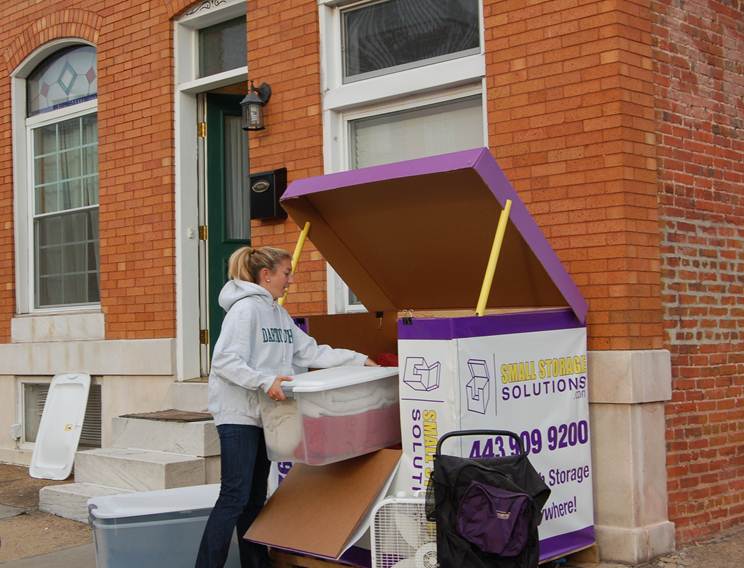
Kennon gave the primary presentation during the meeting and discussed his experience rolling out a start up company in the warehousing and logistics industry.  After he graduated from Dickinson College in 2010, Kennon worked for a think-tank in DC and got involved in a Baltimore planning and development firm as an intern.  In the second half of 2012, an opportunity came up to work for Ruxton Services, a local warehousing, contracting, logistics, and stevedoring company with over 20 years of experience.  However, Kennon’s focus did not include the main business.  Instead, he held major responsibilities with the launch of a new company owned by Ruxton Services called Small Storage Solutions.

Small Storage Solutions offers residents and businesses the opportunity to store unused items in a warehouse for $25 a month.  The idea developed when the owner at Ruxton realized he had way too much stuff in his house and wanted to store it.  Fortunately, he had several hundred thousand feet of warehouse space.  But most people don’t have that option, and the idea for SSS was born.  The service they offer today allows you to drop off stuff you don’t plan to use in the short term, but don’t want to throw out either, and keep it in your own box in a Ruxton warehouse for $25 per month.  This is a significantly cheaper solution than something like PODS.

The business really began to get off it’s feet this past January.  A common thing we continually talk about in these meetings revolves around customer acquisition.  This conversation was no different.  Kennon explained how they initially sent out direct mail pieces throughout the city and had some moderate success.  Direct mail through the post office is “on special” right now and comes relatively cheap, but SSS is also looking for ways to further increase their base revenue.  We discussed social media and if that channel could lead the business closer to a target market as well as a variety of other inexpensive marketing avenues.

Another piece of the discussion centered around growth and the different customer segments open to this type of service.  Immediately, many members in the group jumped on the idea of offering this service to college students over summer break.  The market potential exists there, but Kennon and his team are operating under the Clay Davis mantra, “crawl, walk, then run.”  The hope is that operations can be improved and they can build on their current customer base, allowing them to possibly dabble with a university move out next Spring.

Another market segment they are trying to attack is restaurants, bars, and seasonal businesses.  Many places store decorations (whether it’s for Xmas, Holloween, or St. Patty’s Day), by throwing everything into a back room with the hope they can find it next time they need it.  SSS offers the ability to store all these decorations off-site for $25 per month.

One of the more interesting pieces of the discussion centered around the product/service offering.  SSS currently offers the option to pick up a clients stuff for $45.  They figured many people would use this option but in reality, they have not utilized this service at all.  Everyone prefers to avoid the fee and hand deliver to the warehouse in Dundalk.  It will be interesting to see how their product/offering continues to develop over time as they get more feedback from the marketplace.

Overall, Kennon had an excellent perspective on the topic, being a major contributor in a new company with minimal financial resources.  It will be interesting to see how Small Storage Solutions continues to maximize a minimal marketing budget, develop new services based on customer feedback, and grow its current customer base.

http://www.smallstoragesolutions.com/default.asp

Box

box 2

BBC #10: 3/18/13

Presentation and Presenter: Lessons from a Solar Startup, Mike Kirby

For the 10th meeting of the BBC, I got back in the ring and gave a powerpoint presentation about my experience with a start up solar company for 3 years.  The discussion revolved around the following 3 stages of the business: 1.) Planning to Fail (October 2009-July 2010), 2.) Moving Up (August 2010-December 2011), and 3.)  The Decline (January 2012-Fall 2012) .

The discussion went in a linear direction, highlighting important events and actions that occurred in the business.  We also analyzed how decisions can effect outcomes 6, 12, and 24 months later, both in positive and negative ways.   As we discussed some of the specific actions and experiences in the various stages, I highlighted several lessons I learned that I believe transcend to other businesses, and illustrated them with very real examples.

1. Test Ideas Fast, Test Ideas Cheap

2. Sales: The Only Thing that Matters

3. Early Decisions have Big Consequences

4. Always Be Closing (ABC) is True, but Don’t Forget ABP (Always Be Prospecting)

5. Differentiate

6. Use Caution When Taking On Investors

7. Avoid Crippling Situations

8. Maximize the Opportunities in Front of You

9.  Everyone Innovates During a Crisis –> Innovate Before the Crisis

10. The Status Quo is Easy, Grow through New Challenges

Presentation and Presenter: Rebecca Yarbrough, The Offline Society

Rebecca Yarbrough currently works in the solar industry in a marketing/business development role.  However, over the last year or so, Rebecca and two others have worked on an alternative/compliment for the current mobile dating applications used heavily in the Washington DC area called “The Offline Society.”

Many people in their 20s and 30s use dating apps on their smart phones such as OkCupid.  Rebecca and her team wanted to provide something better than the current online interaction and created the Offline Society to help those “suffering from online dating fatigue.”  Essentially, they host events that match 25 single men and 25 single women from OkCupid.  However, her team does not simply pick 25 random men and women.  They use the OkCupid platform to verify and help manage the planning of the events, but also utilize their own process to handpick a crowd they believe will blend well together.  On top of handpicking a crowd of DC singles, they encourage interaction at the event with different ice breakers and similar activities that you wouldn’t find at a bar.  By including these types of games during the “party,” The Offline Society has so far been able to provide a unique experience that allowed them to increase their price for their second event and still sell out through word of mouth marketing.

The Offline Society charges a ticket price to attend and also brings in revenue from beverage sales.  Two events have been held so far with moderate success.  They sold out both and the response from the attendees has been positive, but one major challenge deals with the time commitment from the Offline Society team.  All 3 women have full time jobs and have found it difficult to drive the business, but do hope to host their 3rd event soon.

Some of the topics we discussed included:

What other revenue sources are available?  What legal issues are relevant? What are the short and long term goals?  Have there been any major challenges?  Successes?  Is a membership model possible?  Pricing issues?  How many events annually?


You can check out their website at theofflinesociety.com.

ofs

BBC #8: 11/26/12

For the 8th meeting of the Baltimore Business Club, we changed the format.  Typically, we have 8-14 members for the meeting and have an introductory period for any new faces to meet the members.  During the introductions, those with new ideas, concepts or technologies they would like to present to the group are now welcome in an open forum before the presentations begin.

At our first open forum, Leap Motion was presented.  Leap Motion is an emerging technology similar to Xbox Kinect that could go main stream in 2013.  The technology uses hand motion to direct a computer screen similar to a mouse, only with your hands.  It has been in development over the last four years, but recently went into program development, and should go live next year.  We viewed the intro video and had a brief discussion.  Check out the video at https://leapmotion.com/.

Presentation and Presenter: Starting an Online Art Business, Chris Diller

Chris has presented the idea of utilizing his graphic and artistic skills to the BBC in the past.  Over the last several weeks, the idea has come full circle and is moving toward a launch.  Chris is a talented painter, and has decided to test the market with his work.  His business idea is to create original pieces of art based on sports, but adding his own unique twist on them or explore an idea that has been developed, but not put on a painter’s canvas.

In the short term, it will be an online business, utilizing shopify, and other online sale sites to sell original pieces of art, oil painting replicas, and posters.  This will give 3 separate price points for each piece he completes; an undecided amount for his original, a $200-$500 for oil paint replicas, and a $20-$30 range for poster prints.

He currently has one final piece that is shown below.  There are 8 oil painting canvas replicas being produced in a test run, and 1 of those replicas has sold on Ebay.  More drawings, a blog, and hopefully more sales are on the way.  Below is his current painting, at 3 feet X 4 feet.

His inspiration for the painting is here:

http://www.youtube.com/watch?v=hmq2dKAP6ZA

http://www.youtube.com/watch?v=QYBz2befSfY


Diller pic

Presentation and Presenter: A & M Imports, Perry and Peter Menzies

Perry and Pete Menzies have been heavily involved in their family’s shipping and warehousing business over the last several years, The Terminal Corporation.  With operations in Canton and Jessup, the family has been involved in the business since the late 1800s.  However, the economic downturn over the last several years led Perry and Pete to help develop new ventures.  With a business history in Brazil through Terminal, an opportunity to import Brazilian wine sprang up 2 years ago and A & M Imports (Alberti & Menzies) was born.

Perry and Pete went through a brief history of Terminal, how it led to the formation of A & M, the challenges they’ve faced in starting a wine importation business from scratch, and the recent successes the new company has seen.  A & M faced many difficulties when it first started and it took nearly a year to navigate through the red tape and bureaucracy involved in importing a new wine brand.  Fortunately, they signed a 5 year contract with the Vinicola Salton Winery in Brazil and received their first container in February 2012.  Vinicola Salton is the largest winery in Brazil by volume, and recently made $12 million dollars in renovations, allowing them to produce 200,000 bottles of wine per day.

It proved incredibly difficult to obtain their importer/wholesaler permit and get the labels approved on the bottles.  These two challenges sucked up months of time before a single bottle of wine could be imported, let alone sold.

Once everything was approved, they still faced difficulties convincing very territorial distributors to take on the new brand.  However, after months of knocking on doors, A & M was able to make headway into local stores and even Fogo de Choa, a nationwide Brazilian restaurant with 20 locations across the country.

These early successes helped them land deals with a few distributors, including Republic National (2nd largest US distributor) to help distribute the wine on a much larger scale than possible with “feet on the street” sales.  The company still has much work to do, but they are poised for success after two long years and should see national distribution in the future.  With the emergence of Brazil in the global economy and the 2014 World Cup placing an enormous spotlight on Brazil, A & M should be a great story and company to follow.   Below are a few pictures from the winery in Brazil and here is the website for A & M Imports (designed by Chris Diller).  http://www.am-imports.com/

Winery 1

Winery 2

BBC #7: 10/23/12

Presentation and Presenter: Marvilent.com, Mike Lopez

Mike Lopez made his first of hopefully many appearances at the Baltimore Business Club.  After getting his MBA with a marketing concentration on the West Coast, he came to Baltimore as an outside sales rep for an engineering firm.   Inspired by his experiences in San Francisco, Mike and a partner launched Marvilent.com, a company that organizes social and adventure events for its customers.  For the presentation, Mike explained the story behind Marvilent, toured his website, and explained some of his plans for the business going forward.  Toward the end, he illustrated some of the major challenges he has faced since launching, which led to an open discussion on ways to overcome some challenges moving forward.

One of the biggest challenges Mike faced thus far is marketing the business.  Marvilent has experienced success, but the company is still bootstrapping, and Mike is exploring various ways to get the word out about his website.  A discussion also opened up looking at different revenue models, including membership payments/discounts, points systems, as well as the current referral program Marvilent has in place.  Some ways Mike is looking to grow the business from here include hosting cooperate events, using social media more effectively (including facebook, twitter, and other photo sharing apps), and forming strong partnerships with local bars and strategic businesses to cross market joint ventures.


Presentation and Presenter: Alternative Ways to Raise Capital, Matt Stout

The second presentation was led by Matt Stout, an “entrepreneur’s lawyer” working out of the Baltimore area.  A business veteran himself, Matt currently focuses on helping his clients buy and sell businesses.  Matt started out, like several presenters have at the BBC, by discussing the merits of The Lean Startup and its concepts, authored by Eric Ries.  The biggest lesson he promoted from the book is to constantly test new products and services as cheaply as possibly to continually revise the offering available to the customer.  By doing so in real life, rather than in theory on spreadsheets, you can make adjustments with a better probability of having the desired effect in the marketplace.

The main part of Matt’s presentation centered around a unique technique to raise capital for small businesses.  Currently, the most well known methods of raising cash for a small business are through friend/family loans, bank loans, angel investing, and venture funding.  Matt presented the idea of raising capital through a seemingly unlikely way, although one that is very possible when investigated further, going Public.  Taking a $1m, $5m, or $10m dollar business Public may seem impossible at first, but it is a very real scenario for some small businesses and can help achieve certain goals when handled properly.

The cleanest way for a small business to go public (it can literally have $0 in lifetime revenue) is through a “reverse merger.”  A merger occurs when a big company buys a little one.  In this case, the opposite happens.  A little company buys a bigger one.  There are many public company’s that currently exist on paper, but don’t actually do any business.  They may have at one point, but currently exist as empty shells.  In a reverse merger, a small company buys the bigger company, brings it’s filings current and essentially restarts a dead company in whatever business the buyer chooses.

There are several advantages to going public for a small company.  All the business’s financials are open and transparent, instantly increasing the value of the company to an outsider.  There is no longer guess work to a company’s value.  It is on public paper.  A business can also raise capital on the smaller public markets, and in some cases, it is easier than raising cash through banks, angel investors, and VC’s.  Another major advantage for a small company being public is the ability to issue stock.  Stock can be used just like cash, and can be issued to buy talent and other companies.  This is something that is extremely complicated in a private scenario, especially when it happens regularly, and is a major advantage for taking a small company public.